Inside the Technology Powering Autonomous Trucks
15 December 2025
Let’s face it—self-driving trucks sound like something out of a sci-fi movie where the Terminator moonlights as a long-haul driver. But guess what? The future is here, and it’s not wearing sunglasses or saying "I'll be back." Instead, it’s powered by artificial intelligence, fancy sensors, and a ridiculous amount of code.
If you’ve ever wondered what sorcery allows an 80,000-pound vehicle to drive itself on highways without flattening everything in sight, buckle up! We're about to take a wild, semi-autonomous ride into the tech that’s reshaping commercial transportation. It’s part magic, part math, and a whole lot of caffeine-fueled programming.
🚛 The Self-Driving Truck Revolution: Why Should You Care?
Aside from the fact that it's insanely cool, autonomous trucks are a game-changer for industries. Think fewer crashes, lower shipping costs, and your Amazon package arriving before you even remember ordering it.Humans take breaks, get sleepy, spill coffee in their laps. Robots don’t. (Well, not yet.) Automated trucking promises 24/7 delivery runs, fuel efficiency, and fewer traffic tantrums.
But how do these digital truckers actually work?
🧠 Artificial Intelligence: The Brain of the Beast
If the truck were a body, AI would be the brains—and not the kind that gets confused when you mix up “effect” and “affect.” We're talking razor-sharp, lightning-fast decision-making.Machine Learning on the Highway
Self-driving trucks learn kind of like toddlers—by watching, imitating, and making a few mistakes (but with less crayon on the walls). Engineers feed autonomous systems terabytes of driving data. The truck learns from patterns: how to change lanes, how to slow down near construction, and yes, how to avoid that one squirrel who refuses to use the crosswalk.Neural Networks: Trucking on a Higher Level
Neural networks are like digital neurons. They process data from sensors and cameras, helping trucks "see" and "think." It's like giving a truck a massive digital brain—with zero road rage.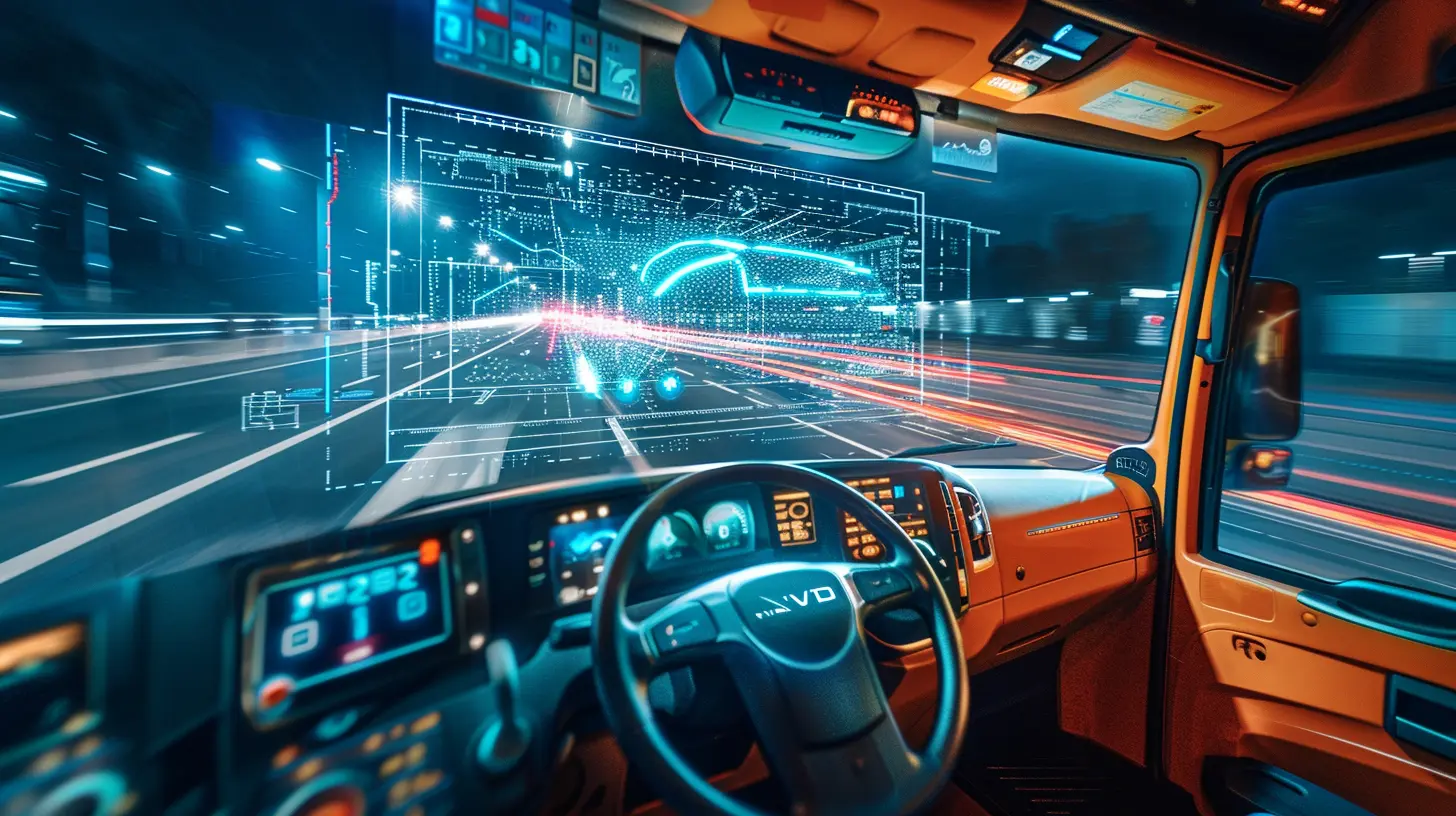
👀 Sensors and Cameras: The Truck's Eyes and Ears
Remember when your mom had eyes in the back of her head? Autonomous trucks take that up a notch—more like 360 degrees of ultra-vision.LiDAR: The Laser Whisperer
LiDAR (Light Detection and Ranging) sounds like something from a Bond movie. It uses lasers to scan the surroundings and create a real-time 3D map. It's essentially the truck throwing light everywhere and shouting, “Who’s there?!” until it figures out what’s going on.Radar: The Unsung Hero of Object Detection
While LiDAR is busy painting pictures with lasers, radar is out there like a truck's trusty sidekick, detecting the speed and distance of nearby vehicles—rain or shine. It’s the all-weather friend we all wish we had.Cameras: Not Just for Selfies
Cameras give the truck vision. Front, rear, side—they’re everywhere. These bad boys help the truck read signs, recognize lane markings, and even spot pedestrians jaywalking like they’re in an action movie.
🧭 GPS and HD Maps: The Truck’s Sense of Direction
No one likes that lost feeling when your GPS yells "Recalculating!" Autonomous trucks avoid that awkward moment with ultra-precise HD maps and GPS.These maps don’t just show roads—they detail stop signs, traffic lights, curbs, potholes, and possibly even the location of every Taco Bell. High-resolution maps are essential for making sure a 40-ton machine doesn’t make a wrong turn into a lake.
💬 V2X Communication: When Trucks Gossip
Yep, trucks talk behind your back. Vehicle-to-Everything (V2X) communication lets autonomous trucks chat with traffic lights, road infrastructure, and even other vehicles.“Hey, I’m about to change lanes!”
“Cool, I’ll slow down.”
Kind of like polite drivers in real life… if only.
V2X reduces accidents, improves flow, and helps these robotic rigs play nice on the freeway.
🧩 The Control System: Turning Data into Decisions
So, we’ve got sensors feeding data, maps showing the road, AI thinking hard—someone’s gotta steer. Enter the control system.This part turns all the information into real-time actions: braking, accelerating, steering, and avoiding runaway shopping carts. It's kind of like a choreographer directing a ballet—if the dancers were monster-sized machines barreling down I-95.
🔒 Cybersecurity: Because Hackers Love a Good Joyride
Imagine a hacker taking your self-driving truck for a spin—not ideal. That’s why cybersecurity is mission critical.Engineers use layers of protection, from encryption to anomaly detection, to ensure trucks can’t be hijacked by a 14-year-old with a laptop and a grudge.
Think of it as a digital deadbolt that even the cleverest cyber-criminal can’t wiggle through.
🔋 Electric and Hybrid Powertrains: Autonomous Trucks Go Green
Here’s where things get extra futuristic. Many autonomous trucks are electric or hybrid. Why? Because saving the planet is cool now.Electric drivetrains mean less pollution, quieter roads, and (hopefully) a smaller gas bill. Combine that with autonomy and you’ve got clean, green, robotic driving machines.
Hey, even Optimus Prime would approve.
🧪 Testing and Simulation: The Truck’s Training Ground
Before hitting the road, self-driving trucks go through more simulations than a video game character.Companies use virtual environments to test reactions to everything from jaywalkers to hailstorms. It's like giving the truck a driving license without risking anyone’s fender. Sort of like The Sims—if your Sims weighed 40 tons and had an obsession with lane departure warnings.
🎮 Remote Operations: Humans Still Have the Wheel… Kinda
Here’s the plot twist: autonomous doesn’t always mean 100% on its own. Many systems include remote human oversight, like a digital co-pilot.If something weird happens—like a tumbleweed invasion or a rogue inflatable dinosaur—remote operators can step in. It's like calling customer support, except they actually help.
🏁 Real-World Players: Who’s Leading the Convoy?
There’s a full-blown tech race going on, and the contenders are impressive.- Waymo Via: Google’s cousin who's all about logistics.
- Aurora: Backed by Amazon and already making test runs.
- TuSimple: Already piloting routes between cities.
- Embark: Working with freight companies to integrate seamlessly.
Even legacy truck manufacturers like Volvo and Daimler are elbowing their way into the party. It’s the Daytona 500 but with data packets instead of octane.
🤔 But Wait… Are They Safe Though?
Ah, the million-dollar question. Safety is the priority. These trucks come packed with redundancies: backup systems, emergency shutdowns, and “oh crap!” buttons.In many cases, they’re safer than human drivers who’ve had too much coffee and not enough sleep. Still, regulations and safety protocols are catching up, but progress is steady.
🌐 The Road Ahead: What’s Next for Autonomous Trucks?
No psychic powers needed—just a look at trends.- More pilot programs are launching every year.
- Improved AI models are learning faster than ever.
- Legislation and infrastructure are sloooowly adjusting to support the tech.
We're inching closer to a future where truckers might work from home, steering their rigs via VR or sipping coffee while an AI does the grunt work. Hide your napkins, folks—the robots are driving.
🍔 Final Thoughts: Should We Be Worried or Excited?
You could say the idea of autonomous trucks is slightly terrifying. Giant robots hauling tons of cargo down the freeway? Yep, adrenaline-worthy.But with the amount of caution, technology, and testing going into this field, it's actually pretty thrilling—in a non-crash-test-dummy kind of way.
We’re not talking about replacing every trucker overnight. It’s more about collaboration: machines doing the long, boring stretches, and humans focusing on the complex stuff. It’s like a buddy cop movie where one’s a robot and the other’s... also tired of traffic.
So next time you see a big rig cruising down the freeway with no one in the front seat, don’t panic. It might just be the future, politely cruising past you with laser eyes and GPS guidance.
all images in this post were generated using AI tools
Category:
Autonomous VehiclesAuthor:

John Peterson
Discussion
rate this article
2 comments
Fleur Robinson
Unveiling the shadows of innovation, autonomous trucks weave through unseen algorithms and secrets. What lies beneath the surface of this technological revolution?
January 24, 2026 at 4:05 AM
John Peterson
Thank you for your thought-provoking comment! Beneath the surface, advanced AI, machine learning, and robust sensor systems drive the innovation, ensuring safety and efficiency on our roads.
Blake McIlroy
Impressive innovation, significant implications.
December 15, 2025 at 5:25 AM
John Peterson
Thank you! I'm glad you found the technology impactful. Exciting times ahead for the industry!