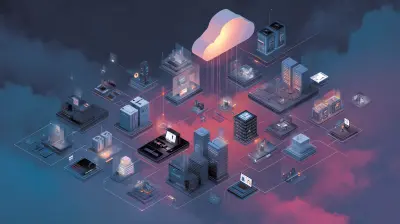
The Future of 5G: How It Will Transform Internet Connectivity
14 December 2025
If you think your current internet is fast, just wait till 5G fully kicks in. We’re not just talking about loading Netflix in a blink or sending massive files in seconds. The future of 5G is about to redefine how we connect, communicate, work, and even live. It’s not just another tech upgrade—it’s a revolution in connectivity.
So, grab a coffee, sit back, and let’s dive into what the future of 5G looks like and how it’s going to change internet connectivity as we know it.
What Exactly is 5G?
Before we leap into the future, let’s quickly cover what 5G actually is.5G stands for the fifth generation of wireless technology. It’s the successor to 4G LTE, which most of us have been using for years. But 5G is more than just faster internet. It’s designed to dramatically increase data speeds, reduce latency (aka delay), and allow for massive device connectivity.
Think of it like moving from a two-lane road to a twelve-lane superhighway. More traffic goes through faster, smoother, and with fewer accidents.
Speed Like Never Before
Let’s get the numbers out of the way.4G LTE gives you a peak speed of around 100 Mbps (megabits per second). With 5G? Expect speeds exceeding 10 Gbps (gigabits per second). That’s 100x faster. To put that in context—you could download a full HD movie in under 10 seconds.
But here’s the kicker—it’s not just speed. It’s what that speed enables.
Almost Zero Latency
Latency is the devil in the details. It’s the tiny gap between you doing something online and seeing the result. With 4G, you might have 30-50 milliseconds of latency. With 5G, we’re talking as low as 1 millisecond.That’s practically real-time communication. For gamers, it means split-second reactions. For surgeons performing remote surgeries with robotic arms, it’s life-saving precision.
Crazy, right?
A Web for Everything: The Internet of Things (IoT)
Now here’s where 5G gets really exciting. With its ability to handle massive device density, 5G will be the backbone of the Internet of Things.We’re talking about smart homes, smart cities, autonomous vehicles, wearable tech—all seamlessly communicating with each other.
Imagine your refrigerator texting your phone because you're out of milk. Or traffic lights adjusting in real time based on traffic flow. That kinda stuff needs lightning-fast, always-on connectivity. That’s what 5G delivers.
Smart Cities: Not Sci-Fi Anymore
Let’s talk urban life. Cities around the globe are gearing up to become smarter. What does that mean? Think of a city that adapts to its people. Traffic managed intelligently, utilities optimized for usage, public safety enhanced with real-time data.5G will power these cities by making sure every camera, sensor, and device is constantly connected and responsive.
In essence, 5G is the glue that will hold smart cities together.
Autonomous Cars: The Road Ahead
Self-driving cars have been in the spotlight for a while now. But for them to become mainstream, they need flawless connectivity.5G ensures that vehicles can communicate with each other (vehicle-to-vehicle or V2V) and with infrastructure (vehicle-to-everything or V2X). This instant data exchange can prevent accidents, manage traffic better, and create safer roads.
A car that knows what’s around the corner before it even gets there? That’s 5G-level intelligence.
Remote Work and Virtual Collaboration
Remember how the pandemic made Zoom a household name? Now imagine virtual meetings with zero lag, lifelike avatars, and real-time collaboration on gigantic data files.With 5G, remote work takes a giant leap forward. We’re talking virtual reality (VR) meetings, augmented reality (AR) training, and even holograms in real time.
No more "Can you hear me now?" moments—just smooth, crystal-clear communication.
The Healthcare Evolution
Telemedicine is already growing, but 5G takes healthcare to the next level.Doctors will be able to monitor patients remotely with real-time data from wearable devices. Surgeries can be performed remotely using robotic tools. Ambulances could become mobile ERs, relaying vital info to hospitals en route.
The possibilities here are more than just convenient—they can be life-saving.
Real-Time Gaming Without the Lag
Gamers, rejoice.5G will usher in an era of cloud gaming like we’ve never seen before. No need for expensive consoles or gaming PCs. With ultra-low latency and high-speed connections, you’ll be able to stream high-end games straight to your phone or tablet.
Imagine playing the latest Call of Duty or Fortnite wherever you are—zero lag, full graphics, seamless gameplay.
That’s not a dream. That’s 5G.
Business and Industry: 5G at the Core
Beyond the consumer world, 5G is transforming industries.Manufacturing
With 5G, factories become smarter. Machines talk to each other. Inventory gets tracked in real-time. Predictive maintenance prevents breakdowns before they happen.Logistics
Supply chains become transparent and trackable from start to finish. Drones and autonomous delivery options become more viable with real-time routing and obstacle detection.Retail
Imagine walking into a store where your favorite items pop up on your phone as you browse, and checkout happens automatically as you leave. 5G-driven retail isn’t just about shopping—it’s about experience.Rural Connectivity: Finally Bridging the Gap
One of the most promising aspects of 5G is closing the digital divide. For years, rural areas have been plagued by poor internet. 5G, especially when paired with low-earth orbit satellites, can bring high-speed internet to places traditional fiber can’t reach.This means better education, healthcare, and business opportunities no matter the zip code.
Everyone wins.
5G and The Environment: Not All Sunshine?
Okay, let’s keep it real for a second. More data, more devices, more energy—right?There are valid concerns around 5G and its environmental impact. However, 5G networks are actually more energy efficient per bit transferred than older networks.
Plus, all the smart tech 5G enables—like optimized traffic and smart energy grids—can help reduce the overall carbon footprint.
So while it’s something to watch closely, it’s not all doom and gloom.
What’s the Catch?
Like any shiny new tech, 5G comes with challenges:- Infrastructure rollout: It needs a lot of small cell towers, especially in dense urban areas.
- Cost: Network upgrades aren’t cheap, and neither are 5G-enabled devices—at least for now.
- Security: More devices means more potential entry points for cyber-attacks.
But as with any tech evolution, these hurdles are being tackled head-on.
The Road Ahead: What Does the Future Hold?
5G is already here in many parts of the world, but we're still scratching the surface of its potential. As coverage expands and devices become more accessible, we’ll see innovation explode.From flying taxis to hyper-personalized digital experiences, the future powered by 5G is going to be wild, wonderful, and always-on.
And guess what? We're just getting started.
Final Thoughts
The future of 5G isn’t just about faster phones or better Netflix streaming—it’s about reshaping the digital landscape. It's about smarter cities, safer roads, more accessible healthcare, and a globally connected world like we’ve never seen before.Whether you're a techie, a gamer, a business owner, or just someone who loves blazing-fast internet, 5G is going to touch your life in big ways.
So get ready, because the 5G wave is coming—and it’s moving fast.
all images in this post were generated using AI tools
Category:
NetworkingAuthor:

John Peterson
Discussion
rate this article
2 comments
Melissa McKellar
This article provides an insightful overview of 5G's potential to revolutionize internet connectivity. The anticipated speed, low latency, and capacity improvements will not only enhance everyday user experiences but also enable innovations in IoT, smart cities, and autonomous vehicles. Exciting times ahead for tech enthusiasts and consumers alike!
December 25, 2025 at 11:34 AM
John Peterson
Thank you for your positive feedback! I'm glad you found the article insightful and share the excitement about 5G's transformative potential.
Jennifer Hernandez
5G represents a significant leap in internet connectivity, promising faster speeds, lower latency, and enhanced device interconnectivity. This technology will transform industries, enabling innovations in IoT, telemedicine, and smart cities, among others.
December 15, 2025 at 5:25 AM
John Peterson
Thank you for your insightful comment! Indeed, 5G's capabilities will revolutionize various sectors and unlock new possibilities for connectivity and innovation.